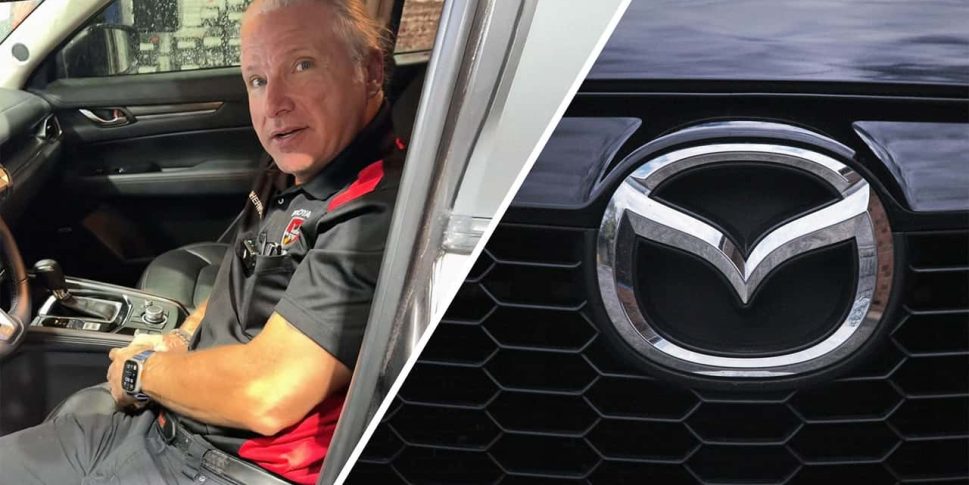
A father-and-son mechanic duo flagged a surprising issue on a 2023 Mazda CX-5—the kind of problem they say they’re seeing more often, even on newer cars.
Royalty Auto Service (@royaltyautoservice), which bills itself as a team trying to bring more transparency to car repair, explained that it took them a minute to nail down what was wrong because the Mazda was so new. They weren’t expecting trouble on a car that fresh off the lot.
The SUV already had serious mileage—96,588—but the mechanics suggest the issue they uncovered shouldn’t be happening this soon.
As of this writing, their clip has pulled in more than 113,200 views.
What Was Wrong With the Mazda CX-5?
In the on-screen caption, the shop warned, “This Mazda is only 2 years old & is already having this problem! This is becoming more common every year!”
They doubled down in the video.
“This is becoming a big problem on a lot of vehicles,” one of them said, noting again that the Mazda “does not sit still for long” with nearly 100,000 miles on the odometer.
He pointed out that the long-term fuel trims were maxed. The car was “stuck at 25%.” Everything else in the data looked normal—until they got to the source of the issue.
The fuel injectors were completely black.
“There’s some carbon buildup on there,” the mechanic explained, adding that they tried cleaning the injectors and “it didn’t help.”
“This is not uncommon,” he said, noting they’d seen the same thing happen to a Ford just a few weeks earlier.
His advice was straightforward: “If you’re not running top-tier fuel, you need to run it.” And while the mileage on the Mazda didn’t help, he said the fix for this kind of buildup isn’t cheap.
Why Is the Fuel Trim Maxed Out?
When the mechanic says the long-term fuel trim is “maxed out,” he’s essentially saying that the engine is getting too much air and not enough fuel, so the computer keeps trying to add more fuel to even things out. Once it reaches 25%, that’s typically the most it can give.
And that’s where the gas comes in.
Using cheaper fuel can absolutely make this worse. According to Cars.com, top-tier gas contains extra cleaning additives that help keep the fuel injectors inside the engine from getting dirty. Those injectors are what spray fuel into the engine, and they have tiny openings. When you use lower-quality gas that contains fewer detergents, those openings start to clog over time.
Once the injectors get clogged, they can’t spray enough fuel. That makes the engine run “lean,” which means there’s too much air and not enough fuel. The car’s computer sees this happening and tries to help by adding more and more fuel. That’s what pushes the trim number all the way up to 25%.
Put simply, your engine needs to take in air and fuel simultaneously to run smoothly, but dirty injectors make it drink less. That’s where top-tier fuel comes in. The extra cleaners in it help keep your car’s injectors from gunking up in the first place, so the engine never gets pushed to that breaking point.
How Long Should Fuel Injectors Last?
According to CarParts.com, fuel injectors can last the life of your vehicle with proper maintenance or 50,000–100,000 miles on average.
The site notes that experts recommend cleaning them every 25,000–30,000 miles.
That said, it adds, “Note, however, that most vehicle owners never have their injectors cleaned and never need to replace a single one for hundreds of thousands of miles. Injector technology has greatly improved since the 1980s.”
If you want to keep your injectors clean, Cars.com states that top tier fuel (and the occasional fuel-injector cleaner if you don’t always use top tier fuel) should be enough. If you intend to use an additive, make sure to check your owner’s manual first, as some manufacturers advise against this.
Unlike tires or air filters, fuel injectors are not parts you need to change routinely. CarParts.com states that you generally only need to replace them if they fail.
Viewers Blame Cheap Gas For Mazda Driver’s Problem
Viewers who watched @royaltyautoservice’s clip were quick to blame cheap gas for the Mazda drivers’ problem. While we can’t say for certain that top-tier fuel would have prevented this specific issue, studies show that using higher-quality gas is better for your car overall. There are dozens of brands that sell top tier fuel.
“Definitely cheap gas,” one user said. “I recommend and do it to my own vehicles, run fuel system cleaner thru the tank once a month. 44k, gumout, seaform, anything’s better than replacing those fuel injectors.”
Another added, “People don’t understand if your car is turbo, you must use premium gas. 91 or 93.”
“I always use top tier fuel,” a third user chimed in. “I’ll pay the higher price rather than pay the price.”
Some commenters even offered tips on where to find top tier gas. “Costco sells top tier regular and premium gas, I think,” one noted.
Others focused on the car’s mileage, noting that it is highly unusual for a two-year-old vehicle to have nearly 100,000 miles. AutoNation USA notes that the average vehicle accrues roughly 10,000 to 12,000 miles per year.
“How can someone drive that much in 2yrs? I’m genuinely confused on how someone can drive 45k plus miles a year,” one said. “I’m only at 11k miles in one year on my 24 Ford Maverick.”
“It has more miles than my 2001 Mitsubishi,” another added.
“I have a 23 MBW with 8k miles on it,” another user commented.
“Rideshare driver guaranteed,” guessed a fourth.
Motor1 has reached out to @royaltyautoservice via a TikTok direct message and to Mazda through email. We’ll update this if either responds.
